The Importance of Credential Distribution Architecture in Privileged Session Management
Introduction
Privileged Access Management (PAM) systems address one of the most important challenges in enterprise security: how to grant privileged access without exposing privileged credentials.
Although most PAM platforms are designed to support this goal, the way credentials are handled during privileged sessions has a major impact on the overall security of the access architecture. In particular, the point at which credentials are injected into the connection flow can determine whether sensitive secrets remain protected or become exposed to client devices.
This article compares two architectural models for using privileged credentials to connect clients to remote endpoints:
- Server-side credential injection into the access traffic
- Client-side credential injection into the access application
It also explains why architectures that distribute passwords to client devices, even temporarily and in encrypted form, can introduce unnecessary security risks and weaken the core promise of Privileged Access Management, especially in the age of AI agents.
Server-side credential injection into the access traffic
Consider the typical privileged session architecture shown below.
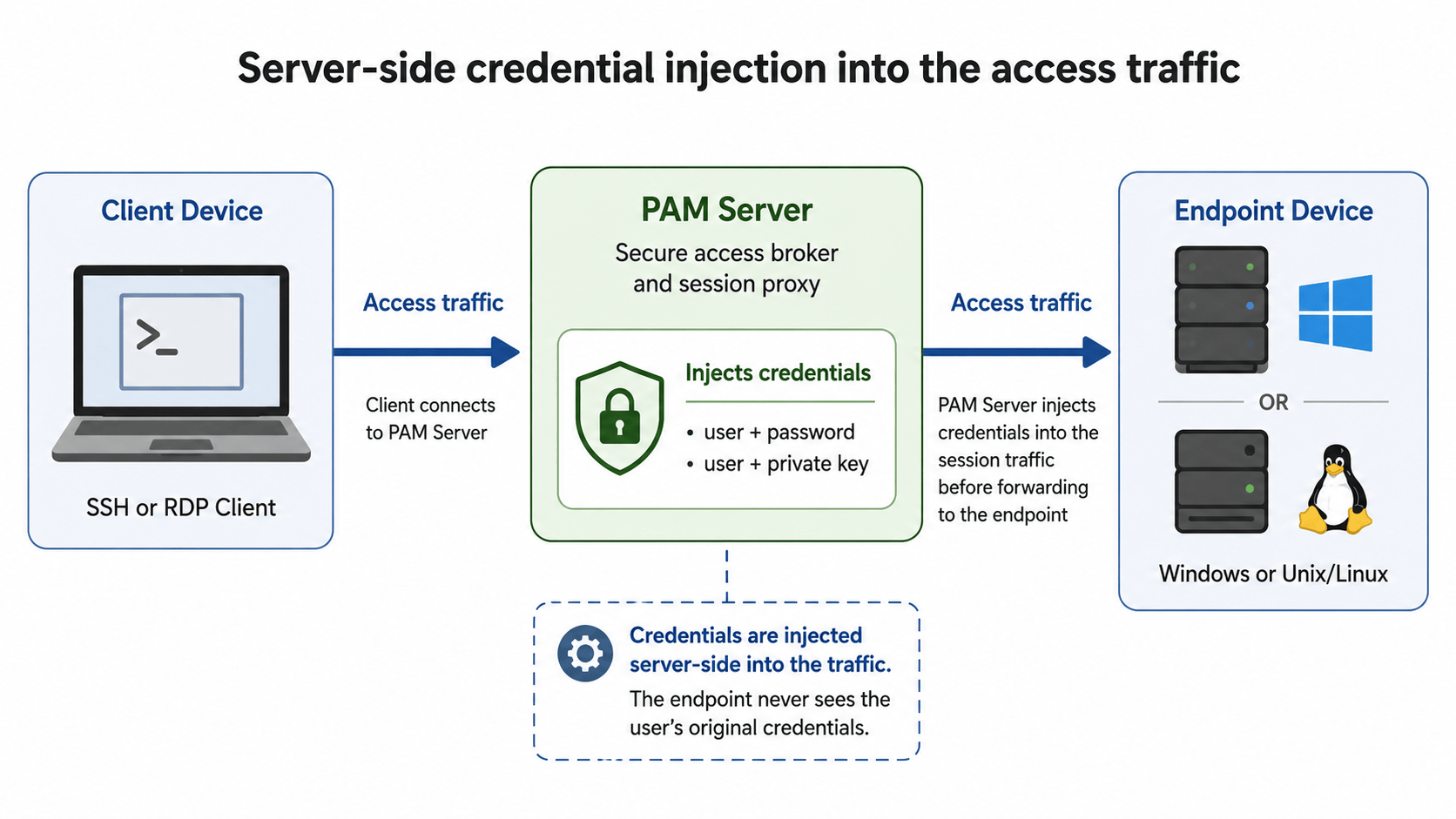
The diagram includes three main components:
- Client-side device with an access application — This application may be a proprietary web client, a desktop client, or a mobile access application such as an RDP, browser, or SSH client.
- PAM server — The PAM server acts as a man-in-the-middle proxy, access broker, or secure gateway between the client and the endpoint.
- Endpoint device — The endpoint may be a Windows or Unix server, a network device, or a web portal.
The sequence of events in this model is as follows:
- The user authenticates to the PAM server from the client-side access application using personal credentials.
- The client-side application initiates a privileged session through the PAM server.
- The PAM server proxies the traffic between the client application and the endpoint.
- At the appropriate point in the protocol flow, the PAM server injects credentials stored in the vault into the access traffic.
- The endpoint authenticates the session using the credentials injected by the PAM server.
In this model, privileged credentials are never sent to the client-side device. The client cannot intercept the credentials through local network components, client-side services, access applications, scripts, or other tools running on the device.
This architecture provides a stronger security boundary because privileged secrets remain under server-side control. The client receives access, but it does not receive the credentials used to establish that access.
Client-side credential injection into the access application
The architecture of agent-based PAM implementations is different. A simplified version of this model is shown below.
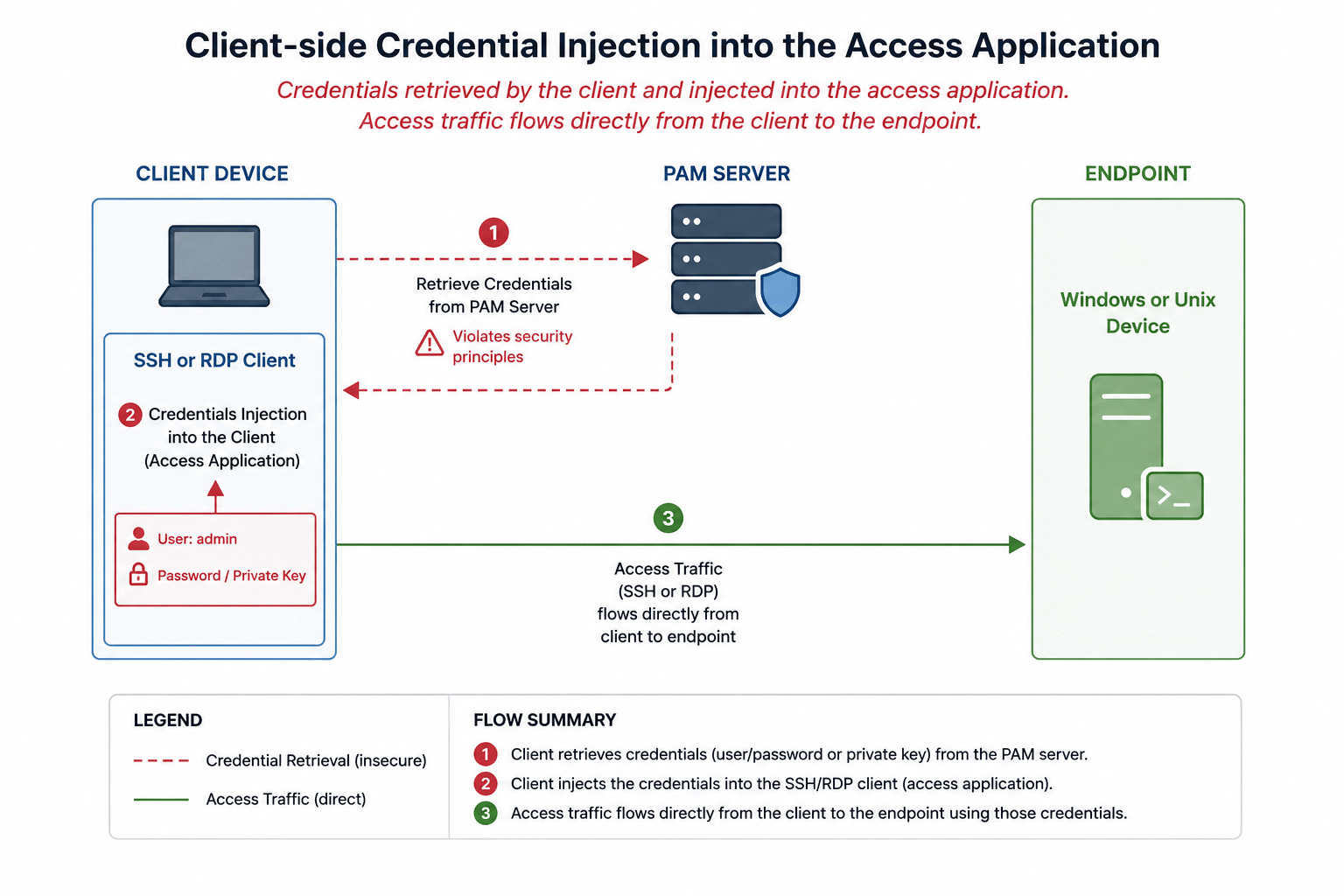
The diagram includes the same three components, but their roles are different:
- Client-side device with an access application — This application may be a proprietary web client, a desktop client, or a mobile access application such as an RDP, browser, or SSH client. In this model, the client-side device often also runs an agent responsible for handling privileged credentials.
- PAM server — The PAM server primarily acts as a credential vault. It stores privileged credentials and provides them to the client-side agent when access is requested.
- Endpoint device — The endpoint may be a Windows or Unix server, a network device, or a web portal.
Although the network components look similar, the interaction model is fundamentally different:
- The user authenticates to the PAM server from the client-side access application using personal credentials.
- The client-side agent requests privileged credentials from the PAM server.
- The PAM server delivers the credentials to the client device, typically in encrypted form.
- The client-side agent decrypts the credentials locally.
- The agent injects the credentials into the local access application. -The client-side access application initiates a direct session with the endpoint.
- The endpoint authenticates the session using the credentials supplied by the client-side application.
In this model, there is a moment, however brief, when privileged credentials such as passwords or private keys are delivered to the client-side device. More importantly, the client-side device must also possess enough information to decrypt or otherwise use those credentials in order to establish the session with the endpoint.
This creates a very different security boundary. Instead of keeping privileged secrets fully under server-side control, the architecture extends credential handling to the client device. Once that happens, the client environment becomes part of the trust boundary for privileged credentials.
This model introduces several important security risks.
First, a proxy or man-in-the-middle component could be deployed in front of the client device by an adversary to observe the credential retrieval process. If the attacker can capture both the encrypted credential payload and the information needed to decrypt or use it, the credential may no longer remain protected.
Second, software running on the client device by a malicious player may attempt to extract credentials locally. This could involve local network monitoring, process inspection, memory scanning, storage analysis, screen scraping, or instrumentation of the client-side agent or access application. Since the credentials must eventually be made usable by the local application, there is a point where they may become exposed to the client environment.
Third, the risk is amplified by modern automation and AI agents. Activities that once required advanced technical skill, such as inspecting local processes, analyzing traffic, searching memory, or building small extraction tools, are becoming easier to perform with widely available information and AI-assisted workflows. As a result, architectures that depend on client-side secrecy face a growing challenge: the client device is no longer a passive access point, but an increasingly capable execution environment.
For this reason, client-side credential injection weakens one of the central security promises of PAM: enabling privileged access without distributing privileged credentials. Even when credentials are encrypted in transit, the architecture still requires them to be delivered to and used on the client device. That design choice increases the risk of exposure and makes the security of privileged access dependent on the integrity of every client endpoint.
Summary
When choosing a PAM solution, it is important to evaluate not only the advertised functionality, but also the architecture used to deliver it.
Agent-based models may appear easier to develop because they avoid deep integration with third-party access applications and network protocols. However, this simplicity can shift the burden of security, maintenance, compliance, and operational risk onto the system owners. If privileged credentials must be delivered to the client device, even temporarily and in encrypted form, the architecture expands the credential exposure surface.
In today’s environment, this distinction matters more than ever. Modern tooling, automation frameworks, and AI agents make it easier to inspect local systems, analyze traffic, interact with applications, and interfere with security controls. As a result, architectures that rely on hiding credentials on the client side are becoming increasingly difficult to defend.
A stronger PAM architecture should keep privileged credentials under server-side control and avoid distributing them to client devices whenever possible. This approach better supports the core promise of Privileged Access Management: enabling secure privileged access without exposing privileged secrets.
For long-term security, compliance, and operational simplicity, organizations should choose PAM solutions built on architectures that are secure by design, easier to maintain, and resilient against modern client-side threats.